The Babylon Fortress in Cairo is the Roman wall the whole city grew out of
The Babylon Fortress in Cairo is the Roman wall the whole city grew out of
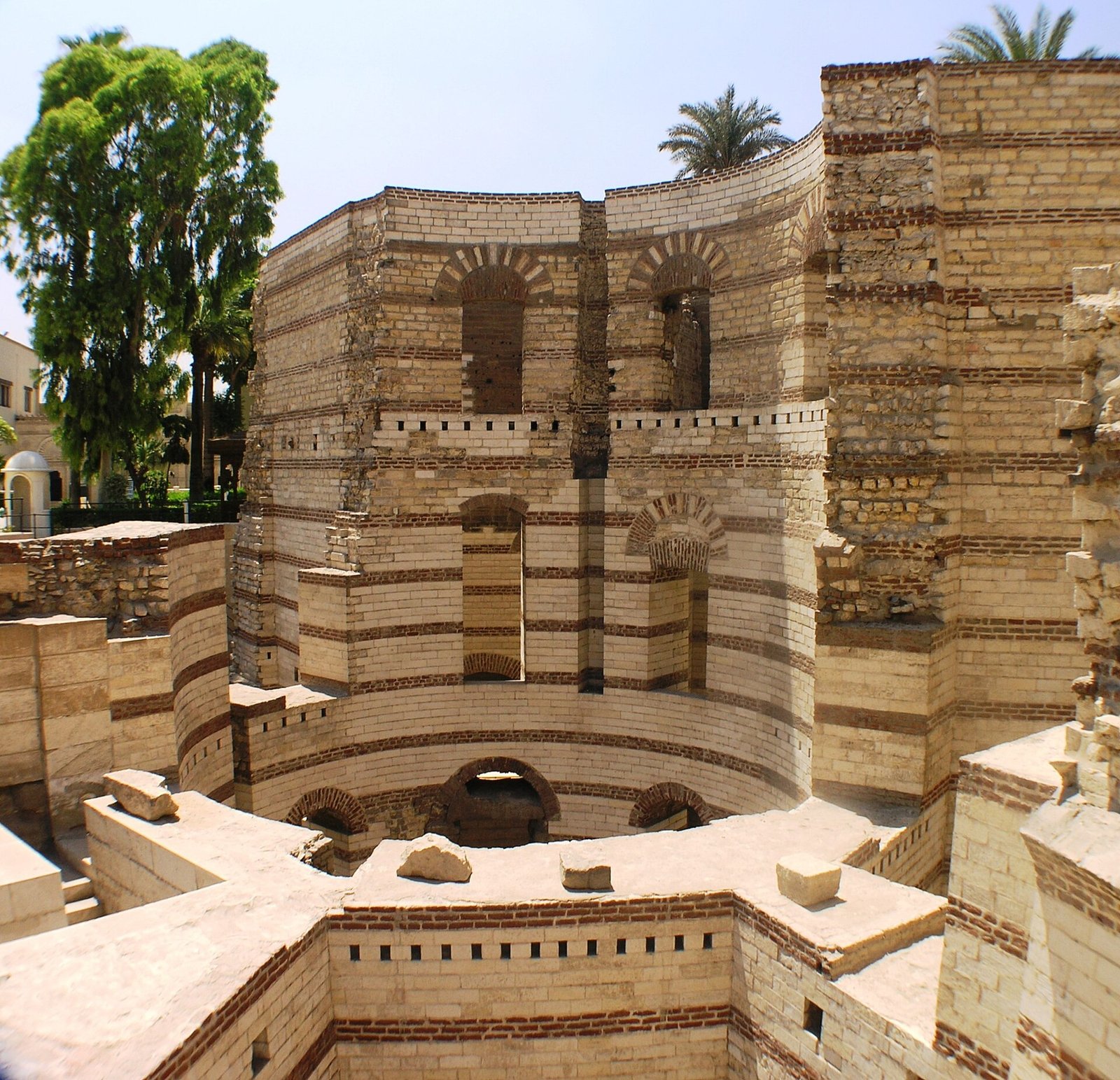
The Babylon Fortress in Cairo is a Roman fort, built under Trajan and rebuilt under Diocletian, that guarded the point where a canal to the Red Sea left the Nile. It has nothing to do with the Babylon of Mesopotamia; the name is a Greek mangling of an Egyptian place name. What survives is a pair of huge round towers striped with red brick and pale stone, the Roman water gate and stretches of wall, with the Hanging Church built on the gate towers and the Coptic Museum inside the enclosure. In 641 the Arab army took the fort and founded Fustat next door, so both Christian and Muslim Cairo began here. You see it as the opening act of the Coptic Cairo walk.
What the Babylon Fortress is, in plain terms
Every big city has a founding spot, and Cairo's is this one. Long before the Citadel and the medieval streets you see on an Islamic Cairo walk, there was a Roman fort on the east bank of the Nile, a few miles south of today's downtown. Romans called it Babylon. Egyptians call the area Qasr al Shama, the fortress of the beacon, or simply Old Cairo.
The fort was a walled rectangle with round towers at the corners and gates, big enough to hold a garrison and control river traffic. Inside it, over the following centuries, the city's oldest churches, a synagogue and eventually a museum were built. The fort did not disappear; it became the skeleton of the Christian quarter that grew inside and on top of it.
| Layer | Who built it | What you see today |
|---|---|---|
| Roman fort | Trajan, rebuilt by Diocletian | Two round towers, water gate, banded walls, sunken Roman level |
| Christian quarter | The Coptic community, from late antiquity on | Hanging Church on the gate, St George on a tower, churches below street level |
| Islamic city | Amr ibn al As, after the siege | Fustat and the first mosque in Africa, a short walk north |
| Museum | Twentieth century | Coptic Museum inside the walls, fortress remains in its garden |
Why the Romans built a fort here: the canal to the Red Sea
The reason for this fort was water, and it is the part most visitors never hear.
At this point on the Nile a canal branched off eastward and ran through the Wadi Tumilat to the Red Sea. The pharaohs dug the first version, the Persians finished it, and the Romans under Trajan cleaned it out and reopened it around the start of the second century. Cargo from India and Arabia could come up the Red Sea, through the canal, into the Nile and down to Alexandria without ever going around Africa.
A canal mouth like that needs a customs post, a garrison and a fortified harbor. Trajan built the first fort at the junction. Around two hundred years later Diocletian rebuilt it on a far bigger scale, with the walls and towers that survive, and a legion was stationed here as the military key to Upper Egypt. The canal itself silted up and died centuries later, which is why no water is visible today.
Why it is called Babylon when it is nowhere near Mesopotamia
This is the first question every visitor asks, and historians are still arguing. Two explanations circulate.
The ancient one comes from Greek writers such as Diodorus. According to them, prisoners of war brought from the real Babylon settled here and named the place after their home city. It is a tidy story of the kind classical authors loved, and most modern scholars treat it as folk etymology.
The explanation that convinces more people today is linguistic. The Egyptian name for the spot was something like Per Hapi n On, the house of the Nile of On, On being the Egyptian name for Heliopolis, the sun temple city a little to the north. Greek speakers squeezed that phrase into sounds they knew, and it came out as Babylon. The Romans kept it, and so did every writer since. No hanging gardens, nothing from the Euphrates, just a place name lost in translation.
The round towers and the banded brick and stone
The two great round towers are the postcard image of the fort, and the first thing you see out of the Mar Girgis metro station. They flanked the water gate on the south side, the entrance boats used when the Nile still ran past the walls.
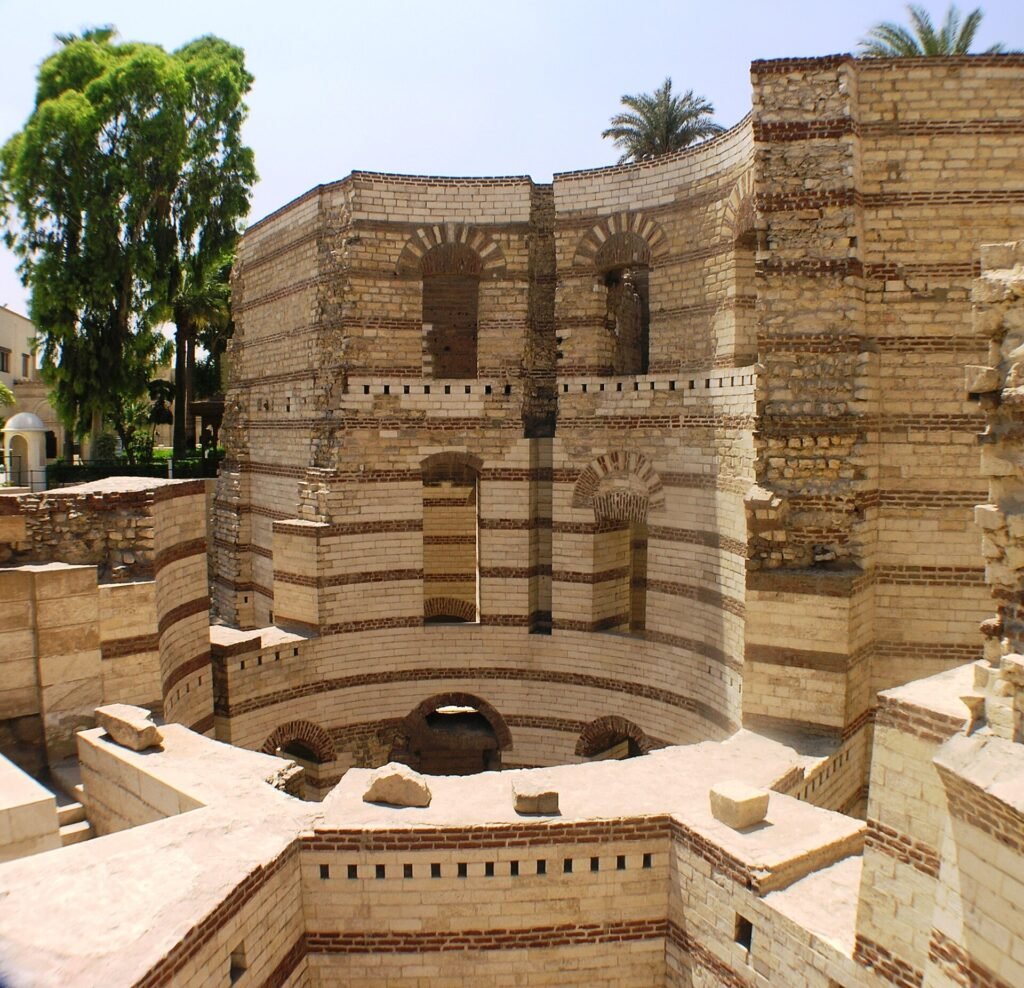
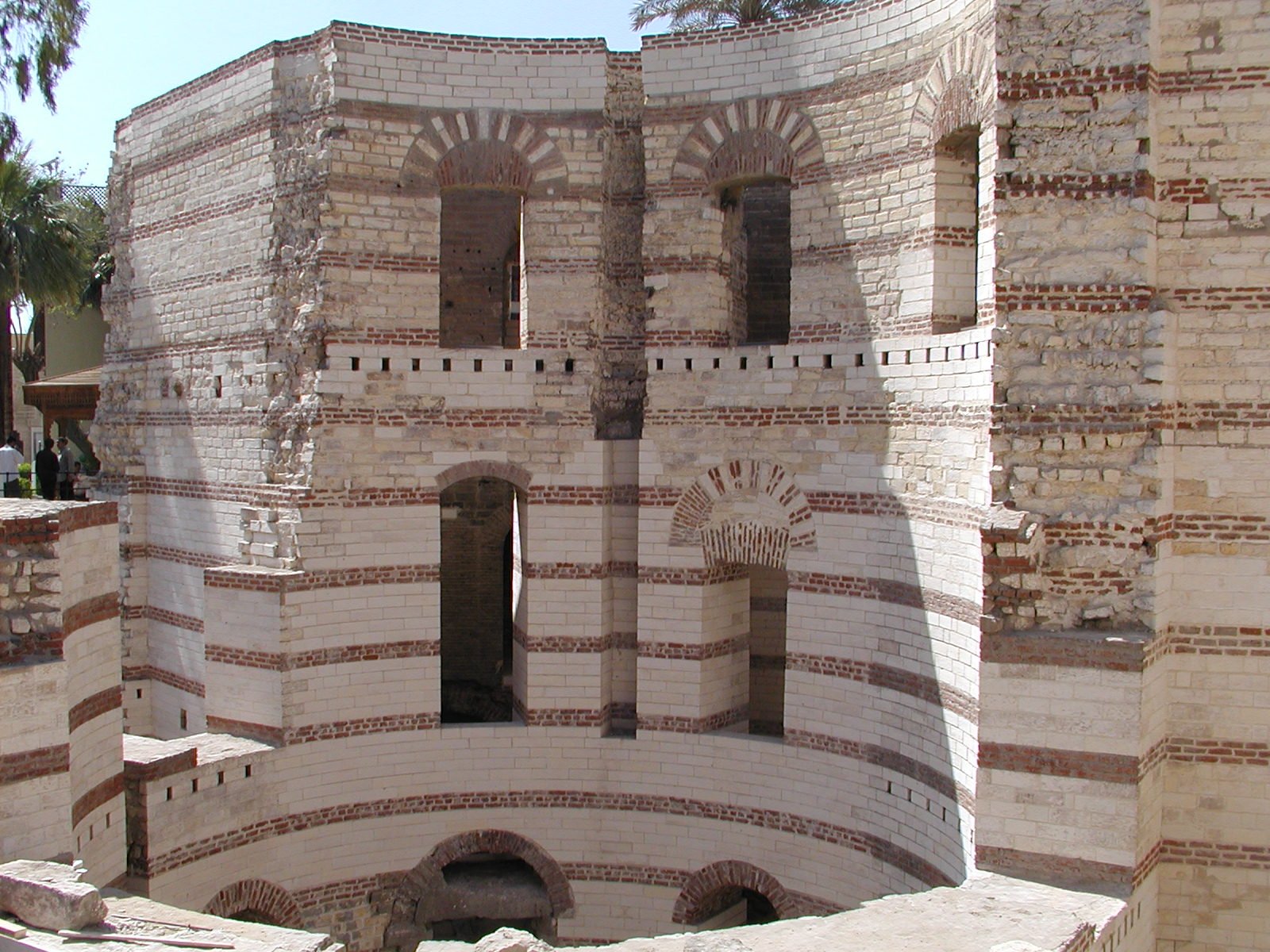
Look at how they are built. Courses of pale limestone alternate with bands of flat red Roman brick, giving the whole tower a striped look. This banded technique is a signature of late Roman military construction across the empire, and in Cairo it is your identification key. Wherever in the quarter you spot that regular alternation of stone and red brick, you are looking at the fortress, not at something medieval or modern.
The towers are wide enough for a whole church to sit on one of them, which is exactly what happened. Their lower halves are below street level because the ground has risen over the centuries. Excavation opened up the base of the towers and the water gate again, so you can look down from a walkway and see the Roman ground level several yards beneath the modern pavement.
The Hanging Church sits on the gate towers
The most famous building in Coptic Cairo is the Hanging Church, Al Muallaqa in Arabic, and its name comes directly from the fortress. It was built over the southern gatehouse, its nave suspended above the passage between the two towers on beams and palm trunks. That is why it hangs.
When you climb the long flight of steps from the courtyard, you are climbing to the top of a Roman gate. Inside, ask your guide to show you the glass panel in the floor that lets you see down into the void of the gate below. It is the one place where the Roman and Coptic layers are visible in a single glance, and most people walk straight over it.
The church has been rebuilt many times, so the interior is medieval and later, but the position has not changed, and for centuries this was the seat of the Coptic patriarch. We keep the icons and the pulpit for the Coptic Cairo guide; here it matters as the roof of the fortress gate.
The Coptic Museum inside the walls
The Coptic Museum stands in the middle of the enclosure, next to the Hanging Church, and it is the second building that owes its position to the fort. It was founded in the early twentieth century to gather Christian Egyptian art, and placed inside the Roman walls because that was where the community's history was thickest.
Two things make it relevant to the fortress. Its garden contains sections of the Roman wall and a tower, so a museum ticket also gives you the quietest view of the fort's masonry. And the collection itself, textiles, carved stone, painted wood and manuscripts, shows Egyptian Christianity growing inside this Roman shell during the centuries when the fort was still a fort.
Plan an hour if you like art and architecture, half an hour if you are there mainly for the stones. Check current opening times on the day; they change with holidays and restoration work.
How the Nile walked away from the walls
Stand at the water gate today and you are looking at a busy street, a metro line and apartment blocks. In Roman times you would have been looking at boats tied up at a quay. The Nile itself has moved.
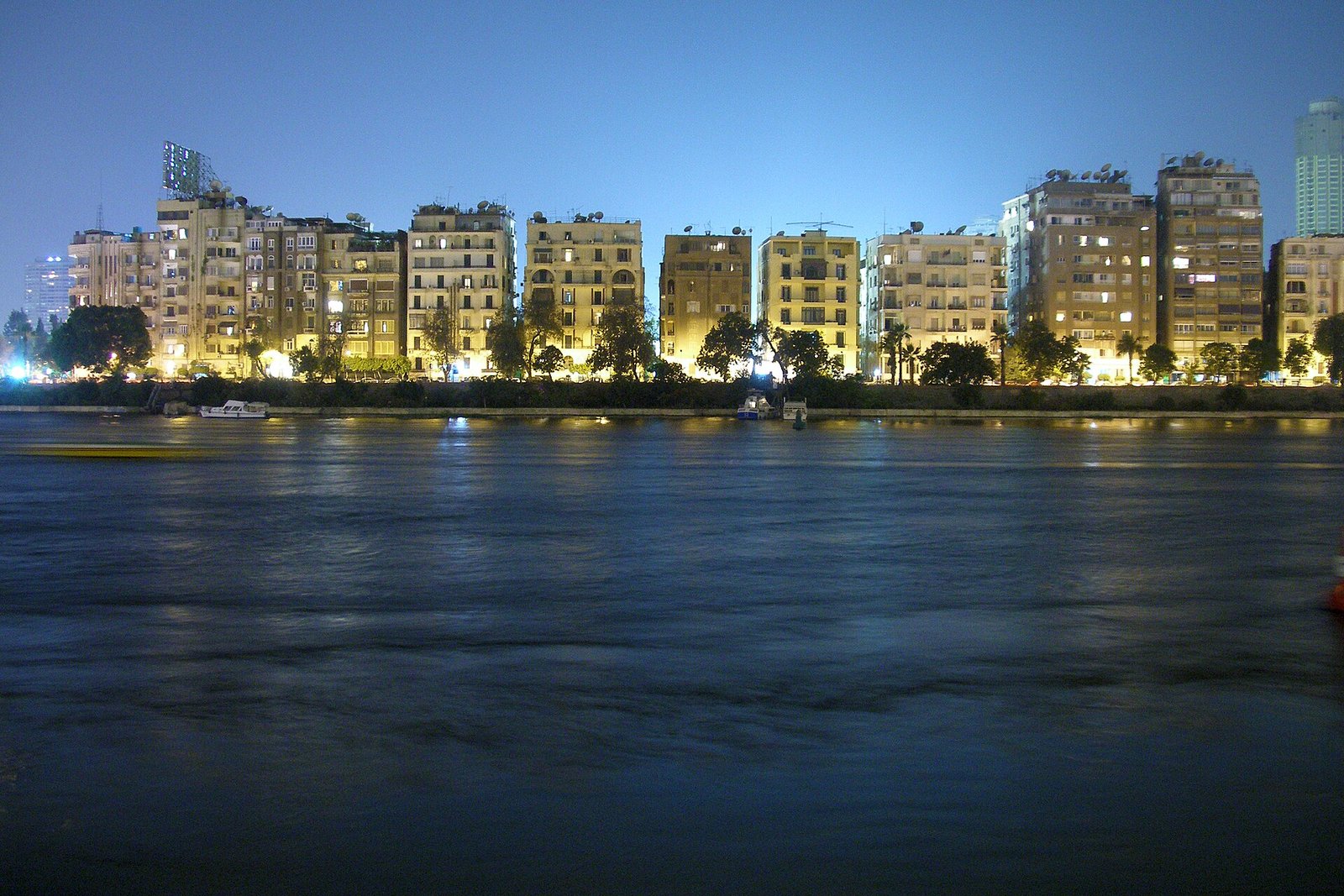
Rivers on a flat floodplain wander. Over the centuries the Nile in this stretch shifted steadily westward, dropping sediment on its east bank and eating into its west bank. The quay silted up, the water pulled back, and the ground in front of the fort became land. Today the river runs several hundred yards to the west, with the island of Roda in between, and the old harbor lies somewhere under the streets.
Something else happened at the same time. Cities rise on their own rubble, and every rebuilt house lifted the ground level around the fort, which is why the churches sit below the street and the Roman floor of the water gate is now a pit you look down into. The fort did not sink. The city climbed up around it. Once you have that, the stairs down into churches and up onto the Hanging Church make sense.
The Arab conquest and Fustat next door
The fortress earned its second claim to fame in the seventh century. When the Arab general Amr ibn al As marched into Egypt, the Byzantine garrison of Babylon was the strongpoint he had to break. The siege lasted through the winter and the fort surrendered in the spring of 641; Alexandria followed, and Egypt passed to the new Islamic state.
Amr did not move into the old fort. He pitched his army's camp just outside the walls to the north, and that camp became Fustat, the first Islamic capital of Egypt. Its mosque, the Mosque of Amr ibn al As, was the first mosque built in Africa and still stands a short walk from the towers, rebuilt many times on the original site.
Fustat grew into a great trading city and then burned in the twelfth century; its ruins spread east of the fort as mounds archaeologists still dig. The Fatimids built their walled capital, al Qahira, a couple of miles north, and the city kept moving that way, which is why Old Cairo sits so far south of everything else on your list.
The sequence is simple: Roman fort, Christian churches inside it, Muslim capital beside it, medieval capital to the north. Visit the Citadel of Saladin the same afternoon and you have walked the whole story of the city in order.
What you can actually see today, and where to stand
The remains are scattered and partly hidden inside later buildings, so it helps to know where each piece is before you arrive.
- The two round towers of the water gate. Directly in front of the Mar Girgis metro exit. Stand back and take in the banded masonry before you go anywhere else; this is the best photograph of the fort.
- The sunken excavation and walkway. Between the towers and below the Hanging Church stairway, a fenced pit with a walkway lets you look down at the Roman gate passage and the original ground level.
- The Greek Orthodox church of St George. Built on top of the northern round tower, reached by a curving staircase that wraps around the drum. From the stair you can put your hand on the Roman brick bands.
- Wall stretches inside the quarter. Along the sunken lane past the churches, look at the lower walls. Where stone and brick alternate, that is fort.
- The Coptic Museum garden. A tower and a run of wall stand in the grounds, quieter and easier to study than the street side.
Allow forty minutes for the fortress elements alone, and two to three hours with the churches, the synagogue and the museum. The lanes are pedestrian, flat apart from the stairs, and shaded for much of the day, one of the easiest walks in Cairo in warm months.
How it fits the Coptic Cairo walk, and what a guide adds
You will not visit the Babylon Fortress on its own. It is the first fifteen minutes of the Coptic Cairo walk, then it keeps reappearing as you move through the churches, and it frames the museum at the end. The full route through the quarter is in the Coptic Cairo guide; the fort threads through it like this.
- Towers first, from the metro exit or the car, before the crowds head for the church stairs.
- Walkway over the sunken water gate.
- Up to the Hanging Church and the floor panel over the gate.
- Down the sunken lane to Abu Serga, St Barbara and the Ben Ezra synagogue, noting the Roman wall bases.
- St George on the tower, then the Coptic Museum and its garden.
Can you do that without a guide? You can walk it, yes. What you will miss is the reading of the stones. Without someone pointing at the brick bands, most people photograph the towers, climb into the church and never realize they have walked through a Roman gate. A good guide ties the canal, the river's move, the siege and the churches into one story, and knows which chapel or gallery is closed for restoration this month.
Our Cairo guides are Egyptian, licensed, and used to American travelers who ask a lot of questions.
How Explora Egipto slots the fortress into your Cairo days
Explora Egipto is a local agency in Egypt with its own guides and vehicles, and Old Cairo is on nearly every Cairo program we build. The usual shape is a full day that pairs the fortress and Coptic quarter with the Citadel and Islamic Cairo, so you see the city grow from its Roman root to its medieval streets in one loop. On a tighter schedule it becomes the afternoon after the pyramids.
| Your Cairo time | Where the fortress goes |
|---|---|
| One day | Pyramids in the morning, Old Cairo with the fortress and Hanging Church after lunch |
| Two days | Day 2 morning: fortress, Coptic quarter and Coptic Museum; afternoon: Citadel and Al Muizz street |
| Three days or more | Half a day at a relaxed pace, plus Fustat and the Mosque of Amr for the conquest story |
For a two-day plan that already has this built in, see our Cairo in two days itinerary, and for the wider list of what to fit around it, our what to see in Cairo guide or the ready-made Cairo excursions. If you are combining Cairo with a Nile cruise, we place Old Cairo on whichever day works with your domestic flight. Everything is private, with a guide and driver. Tell us your dates and we send you the quote.
Frequently asked questions
What is the Babylon Fortress in Cairo?
It is a Roman military fort in Old Cairo, first built under Trajan to guard the mouth of a canal from the Nile to the Red Sea and rebuilt on a much larger scale under Diocletian. Its round towers, water gate and banded walls survive, and Coptic Cairo grew up inside and on top of it. The Arab army took the fort in 641 and founded Fustat, the first Islamic capital of Egypt, beside its walls.
Is it connected to the Babylon in Iraq?
No. The name is a coincidence of sound. Ancient writers told a story about Babylonian prisoners settling here, but most scholars now think the Greek word Babylon is a corruption of an Egyptian place name meaning something like the house of the Nile of On, On being Heliopolis. Nothing about the site is Mesopotamian.
What is left of the fortress today?
The two big round towers of the southern water gate, the gate passage itself, which has been excavated and can be seen from a walkway, and stretches of wall built in alternating bands of stone and red brick throughout the quarter and in the Coptic Museum garden. The Hanging Church stands on the gate and St George on one of the towers, so parts of the fort are inside later buildings.
Why is the Hanging Church called hanging?
Because it was built over the passage of the Roman south gate, with its nave resting on beams laid across the space between the two gate towers. It hangs above the Roman void rather than sitting on solid ground, and a glass floor panel inside lets you look down into the gate.
Why is the fort so far from the Nile now?
The river moved. In Roman times the Nile ran right past the water gate and boats moored at the walls. Over the centuries the channel shifted west and the old bank silted up, so the river now runs several hundred yards away with the island of Roda in between. The ground level also rose on centuries of rubble, which is why the Roman floor is now well below the street.
How long does a visit take and do I need a guide?
The fortress elements take about forty minutes; with the Hanging Church, the sunken churches, the synagogue and the Coptic Museum, plan two to three hours. You can walk it alone, but the Roman story is invisible without someone reading the masonry for you. We include it with a private guide in our Cairo tours; ask us for the quote.
Start your Cairo story at the Roman gate
Tell us your dates, your hotel and what else is on your Cairo list, and we send back a plan with the Babylon Fortress and the Coptic quarter placed on the right day, with a licensed guide who can read the brick bands for you. No prices here, only a quote in your inbox.